Historic Plaques of Downtown Hudson
Every building on Main Street has a story. The Hudson Downtown Business Improvement District (BID) installed historic plaques on buildings throughout downtown, each one sharing a piece of the building's past: when it was built, who first owned it, and the businesses that called it home over the years. Use this page as your guide for a self-guided walking tour, or just to learn a bit more about the places you already love.
Explore the Plaques

51–57 MAIN STREET
The Graves and Woodbury buildings located on these parcels were originally three-story brick structures constructed following the Great Fire of 1894. Before the arrival of F.W. Woolworth, the Graves Block (51–53 Main St.) housed several clothing retailers, with Woolworth occupying the space from 1932 to 1961. The Woodbury Block (55–57 Main St.) was home to a number of grocery stores prior to becoming the long-term location of W.T. Grant, which operated there for nearly three decades before moving to 31 Washington Street.
In 1961, both properties were sold to Louis Gould, who rebuilt the two three-story buildings into a single one-story structure. Godin's 5 & 10 occupied the site from 1962 to 1982, alongside McCormick's Drug Store, which operated from 1969 to 1992. The Salvation Army Thrift Store occupied space from 1982 to 2013. In 2013, Petros Muratoglu purchased the building and undertook a full renovation before opening The Bagel Factory in 2017.

59–61 MAIN STREET
Constructed between 1866 and 1867, this building is recognized as one of the oldest surviving commercial structures in the downtown area. It withstood significant historical events, including an 1880 fire on the east side and the devastating Great Fire of 1894, which originated on the west side and destroyed approximately five acres of downtown property.
In the early to mid-20th century, the building was home to a fruit store, a cobbler, and a women's clothing shop. In 1954, Irving Dinner acquired the property and relocated Wright's Jewelry from across the street to this location. The business was passed down to his son and daughter-in-law, Lee and Kathy Dinner, in 2007.
In 2020, Wright's Jewelry was sold to Justin and Jenna Beit, who subsequently moved the business to 12 Pope Street in 2025.

63–67 MAIN STREET
The structure known as the Hudson House Hotel, Restaurant and Market was constructed in 1881 by James and Floretta Sawyer, following the destruction of the original building in a fire the previous year. The property remained in the Sawyer family until 1920, when it was sold to the Miller brothers. The new owners altered the façade, applying stucco above the roofline as a protective measure to prevent snow from sliding off the roof onto pedestrians below.
Over the years, the building has hosted a variety of street-level businesses, including Sharon's Restaurant, the Looking Glass Hair Salon, Don's Shoes, and Art Phaneuf's Barber Shop. The second and third floors functioned as a rooming house until a renovation in the 1990s converted the upper levels into studio and one-room apartments. In 2014, additional apartments were added along the Market Street side, repurposing space formerly occupied by businesses such as Tom's Taxi, Donohue's Driving School, and Ike's Bytes.

COCHRAN BUILDING
1894 · Renaissance Revival Architecture
This building originally housed the Cochran Pharmacy that later became O'Brien's Drugstore, featuring homemade ice cream. In the late 1950s it became McCormack's Drug, which eventually moved to 51 Main Street. In more modern times, former tenants included the Newton-Waltham Bank and BayBank.

LAWRENCE BUILDING
1894 · Renaissance Revival Architecture
Earliest tenants include the Feltonville Post Office, Pete's Store and the Hudson Home Laundry. The Hudson Lodge of Elks also owned the building for many years and occupied space on the upper floor. S. B. Fairbanks Co. and Wood Square Hardware also called this building home. In more modern times, tenants included Siger's Sports (which had relocated from 127 Main Street), Hat's Off Deli and Chloe's Restaurant.
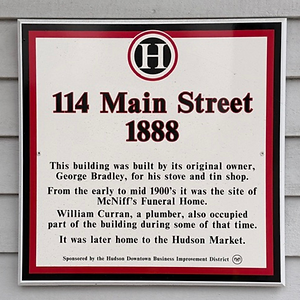
114 MAIN STREET
Built 1888
This building was built by its original owner, George Bradley, for his stove and tin shop. From the early to mid 1900s it was the site of McNiff's Funeral Home. William Curran, a plumber, also occupied part of the building during some of that time. It was later home to the Hudson Market.

127 MAIN STREET
Built 1909
Built in 1909, this building first housed W.L. Person's Optometry and a jewelry store. Fred Dawes later sold Indian Motorcycles there before shifting to electrical supplies. From the 1940s to the 1960s, Monreau's Quality Bakery occupied the left half, while Siger's Sports was on the right. In the early 1980s, Corrado's Amusement, a pinball and video arcade, took over the space. In 1989, Salvatore Lando purchased the building and opened T.C. Lando's.

154 MAIN STREET
In 1874, the property was listed as a saloon in the registry of deeds. In 1886, it was sold to Lizzie McCarthy, wife of Charles J. McCarthy, and continued operating as a saloon and liquor store, with a stable, until Charles' death in 1904.
From the 1930s to the 1960s, Joseph McCarthy ran McCarthy's Hotel and Bar, which included the "Jolly Roger" room with bowling alleys. The building also housed Art Phaneuf's Barber Shop on the left side and the BCL Lounge, later known as Billy Jack's, on the right. Billy Jack's closed in the late 1990s, after which the space became Basil Bistro, a Thai restaurant, and later Sophia Ristorante, which operated until 2020.
The current owner has been running Manzo's Rooming House on the upper floors since 1998.

SEYMOUR BLOCK
1889 · 165 Main Street
Built on the site of the former Houghton Park, this building originally housed a grocery store, variety store, fruit stand and twelve mostly one-room apartments. Former tenants include both Morel's and Fearing's Market, Hudson Printers, Quintin's Barber Shop, Hudson Tape Center and Corrado's Pizza. Six additions have been added since the 1970s, with a full renovation in 1989.

169–183 MAIN STREET
This location was formerly a large grass park with a beautiful fountain. The current building's past tenants include the Miller & Hudson Drug Company, Toohey's Pharmacy and the Bar Lunch. A dance studio occupied the second floor. In 2008, the building was remodeled and combined with the adjacent Seymour Building.

FLAX BLOCK
Constructed in the mid-1920s
Former tenants included Bill Molloy's Corner Store (a favorite of the neighborhood kids), Country Electronics, Frank's Cycle Shop, Restaurant Atlanta and numerous other ventures, including a cobbler that once occupied the west end of the building. In the mid-20th century, the town rejected a proposal to demolish the building and put up a gas station.

8 MARKET STREET
Built 1895
Built in 1895 and owned by William H. Chase, this building was constructed by Amos Powers, who also built the main fire station at 1 Washington Street. It was initially occupied by Holden Brother's Bakery. In the 1930s, it became Tony's Brass Rail, known for its "famous spaghetti." Later, it housed liquor stores before becoming Gil's Barber Shop in the 1970s. In the early 1980s, the second floor was leased to the Keymen Soccer Club. In 2003, it became Sereni Salon.
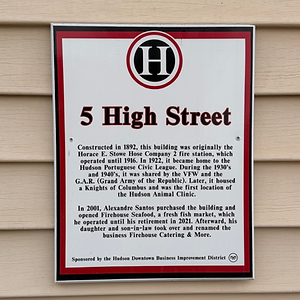
5 HIGH STREET
Built 1892
Constructed in 1892, this building was originally the Horace E. Stowe Hose Company 2 fire station, which operated until 1916. In 1922, it became home to the Hudson Portuguese Civic League. During the 1930s and 1940s, it was shared by the VFW and the G.A.R. (Grand Army of the Republic). Later, it housed a Knights of Columbus and was the first location of the Hudson Animal Clinic.
In 2001, Alexandre Santos purchased the building and opened Firehouse Seafood, a fresh fish market, which he operated until his retirement in 2021. Afterward, his daughter and son-in-law took over and renamed the business Firehouse Catering & More.

THE AZOREAN HERITAGE MURAL
This mural depicts the migration of Portuguese immigrants from the Azorean Islands during the 20th century. In the late 1970s, nearly one third of Hudson's population was of Portuguese ancestry, and they made up much of the workforce in Hudson's many shoe and woolen factories, as well as area high tech manufacturers that were in operation during that time. Their cultural influences and strong work ethic contributed greatly to Hudson's charm and prosperity.
Make a Day of It
After your plaque walk, grab a bite, browse the shops and see what's happening downtown. Check out the Business Directory for places to eat and shop, and visit our Events calendar to plan your next trip to Downtown Hudson.
